Fraud Blocker
All Blogs
Restaurant Tips

The uncomplicated math of restaurant profitability

Restaurant profitability is under pressure. Learn the key margin benchmarks, cost drivers, and operational levers multi-unit operators use to protect profit.

ABOUT THIS RESTAURANT

Service Type

Locations:

Location

POS Used

See how Fresh KDS can impact your kitchen efficiency today.
Get started
Simplify your kitchen operations with Fresh KDS.
Get started — it's free

The restaurant industry is on track to hit $1.55 trillion in sales in 2026. That number should feel like cause for celebration. Instead, nearly half of operators say they aren't turning a profit — and for multi-unit CFOs managing the gap between top-line growth and bottom-line reality, that tension is anything but theoretical.

The uncomfortable truth is that revenue and profitability are two very different problems. Real, inflation-adjusted growth across the industry remains modest, and rising costs continue to outpace what operators can recover through menu pricing. The industry isn't shrinking. It's just getting harder to make money in it.

This post won't offer a think piece on macroeconomic trends. It's a clear-eyed breakdown of the math every multi-unit CFO should have memorized: the margin benchmarks by concept, the cost formula that drives every P&L, where operators are losing ground right now, and what the highest performers are doing differently to protect margin in a difficult environment.

Know Where Your Concept Stands

Before pulling any levers, you need an honest baseline. Margin ranges vary meaningfully by concept type, and conflating them is a fast way to set the wrong targets.

  • Quick-service: 5–8% net margin
  • Casual dining: 5–7% net margin
  • Fine dining: 6–10% net margin
  • Full-service average: 3–5% net margin

Those numbers tell a nuanced story. Fine dining can outperform QSR on margin, but with far less volume cushion. Full-service operators sitting at 3–5% are one bad quarter away from break-even. And the benchmark worth chasing: according to the 2026 State of Restaurants Report, top-performing full-service restaurants are averaging 10.5% net profit margins, which is more than double the full-service average. 

For CFOs overseeing multiple units, the more important number might not be the overall average, but the variance across locations. A 2% swing in net margin per unit is a material difference in annual earnings. Identifying and closing that variance is one of the highest-leverage financial activities in a multi-unit portfolio.
Serve every order on time

​​The Core Cost Formula: Three Numbers to Run Your Business

Strip away the complexity, and profitability comes down to one equation:

Revenue − Controllable Costs - Fixed Costs = Profit

To increase profit you must either grow revenue or reduce costs. For restaurants, there are two major controllable costs: food cost and labor cost. Fixed costs, like rent, don’t change with sales volume. It’s important to have enough revenue to cover your fixed costs because then every additional sale contributes a percentage to your profit. 

​​Where Profitability Is Breaking Down Right Now

The warning signs are widespread and well-documented. 42% of operators reported that their restaurants were not profitable in 2025 and had limited ability to raise prices further to compensate. 39% said their business was not profitable in 2024. And the demand side of the equation isn't holding up either. 61% of operators reported declining customer traffic between 2023 and 2024. 

Two forces are converging to create this profit squeeze:

  1. Cost inflation: Food, labor, and overhead costs continue to rise faster than menu prices can absorb. Operators who have already taken aggressive pricing action are finding diminishing returns. Guests are pushing back, and further increases risk accelerating the traffic declines already in progress.
  2. Traffic erosion: Consumers are pulling back. Tighter household budgets are reducing visit frequency across segments, which makes top-line revenue growth increasingly difficult to generate through volume.

For multi-unit operators, these dynamics compound. When volume declines, it takes longer to cover your fixed costs and your margin for error becomes razor thin. If the root cause of your profitability problem is low revenue then trying to compensate by cutting costs is going to create a downward spiral. 
Why Guest Experience Matters for Long Term Revenue

People choose where to dine based on a few factors. The top drivers of choice are the type and quality of food, the price and value of the meal, and the overall experience, which includes things like speed of service, order accuracy, and staff friendliness. Imagine two guests who are both trying your restaurant for the first time. Let’s say each spends $50 on their visit. Today both of these guests are worth the same amount of money to you. Now, imagine that one of these guests has a great experience. Their food is served quickly, prepared correctly, and tastes good. The other new guest, however, had a terrible experience. They had to wait 25 minutes for their entrees, and when the food finally came out it had the sauce on the meat instead of on the side as the customer requested. 

The first guest is much more likely to return to your restaurant. Their revenue over the next year will be $50 times the number of repeat visits. The second guest is less likely to return, and if they never return their total revenue is only $50. Great experiences lead to more repeat visits which leads to higher revenue. If you focus too much on cutting costs at the expense of being properly staffed or offering a quality product then you might be able to boost profit in the short run, but in the long run you’ll likely see your revenue decline due to fewer repeat customers. When revenue goes down, you might start spending more on marketing or loyalty programs to drive customers back into your restaurant. But if you fail to convert those customers into regulars, the marketing spend isn’t producing a solid ROI. 

The Profitability Levers That Actually Move the Needle

Given these challenges, where do high-performing operators focus? Here are three things to focus on that aren’t just “cutting costs”. 
1. Order Accuracy

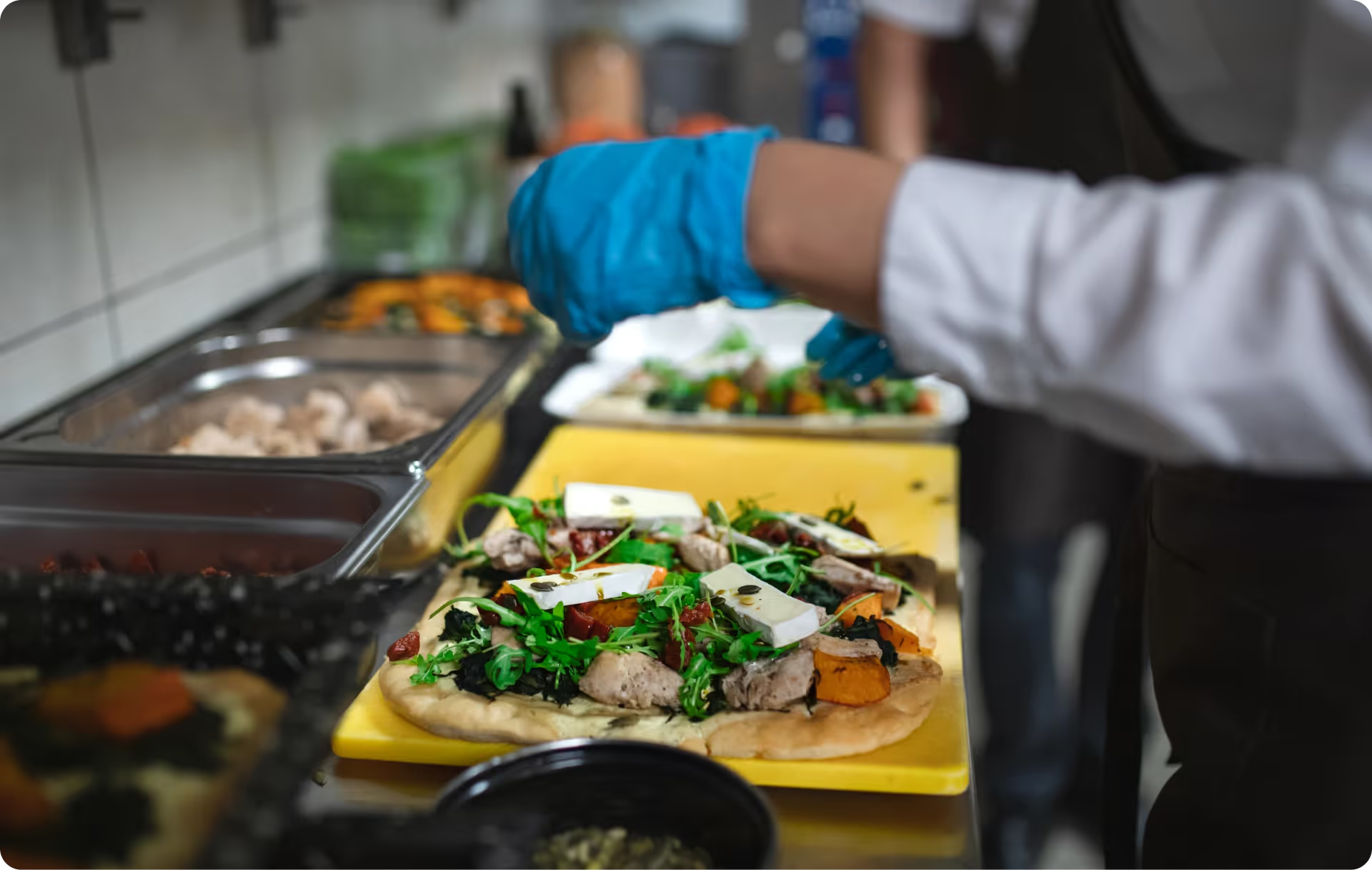
Preparing orders correctly improves profitability in two ways. First, it lowers your food waste by removing the need to remake the order. Unlike commodity prices, which are largely a macro trend out of your direct control, minimizing food waste is something you can impact. Second, incorrectly prepared orders create a terrible guest experience, which has the potential to impact future visits and long term revenue. 

Using a kitchen display system to route items, highlight modifiers, and give the kitchen staff easy access to plate build information will improve food waste (and therefore food cost) in the short run and revenue over time.

2. Speed of Service

Speed of service is often discussed as an operational metric. It's equally a revenue metric, both in the short run and the long run. Slower ticket times during peak periods mean fewer covers served per shift, which means less revenue generated per labor dollar spent. When a kitchen falls behind during a Friday dinner rush, the losses are felt immediately for that day.

But poor speed of service connects directly to the traffic erosion problem. When kitchens fail to meet guest expectations consistently, visit frequency drops. And lower visit frequency is a direct, compounding revenue problem, not a one-time event. A KDS optimizes order flow and helps kitchens maintain speed and accuracy under volume pressure, protecting both the guest experience and the revenue per available seat hour.

3. Reduce Labor Waste — Not Just Labor Cost

The goal isn't headcount reduction. It's maximizing output per labor hour. Confusion, miscommunication, and re-work in the kitchen are invisible labor costs. They burn hours without generating output. Operational tools that reduce friction allow existing staff to do more, handle higher volume, and make fewer errors.

This matters especially given that the average restaurant was short five employees in 2025. Operators aren't going to hire their way out of a labor market that remains structurally tight. They need to get more from the teams they have, and that starts with giving those teams cleaner operational systems.

The Bottom Line

The math hasn't changed. Margins are thin, costs are rising, and traffic is soft. The operators who will win in this environment are those who find margin through operational efficiency and revenue maximization. They treat every part of the business, including the kitchen, as a financial lever.

Audit kitchen operations with the same rigor applied to financial statements. What happens at the line shows up on the P&L. Modern tools like a KDS aren't overhead. They're infrastructure for protecting margin at scale, across every unit, every shift.

Ready to try Fresh KDS in your restaurant?

April 24, 2026

The uncomplicated math of restaurant profitability

The restaurant industry is on track to hit $1.55 trillion in sales in 2026. That number should feel like cause for celebration. Instead, nearly half of operators say they aren't turning a profit — and for multi-unit CFOs managing the gap between top-line growth and bottom-line reality, that tension is anything but theoretical.

The uncomfortable truth is that revenue and profitability are two very different problems. Real, inflation-adjusted growth across the industry remains modest, and rising costs continue to outpace what operators can recover through menu pricing. The industry isn't shrinking. It's just getting harder to make money in it.

This post won't offer a think piece on macroeconomic trends. It's a clear-eyed breakdown of the math every multi-unit CFO should have memorized: the margin benchmarks by concept, the cost formula that drives every P&L, where operators are losing ground right now, and what the highest performers are doing differently to protect margin in a difficult environment.

Know Where Your Concept Stands

Before pulling any levers, you need an honest baseline. Margin ranges vary meaningfully by concept type, and conflating them is a fast way to set the wrong targets.

  • Quick-service: 5–8% net margin
  • Casual dining: 5–7% net margin
  • Fine dining: 6–10% net margin
  • Full-service average: 3–5% net margin

Those numbers tell a nuanced story. Fine dining can outperform QSR on margin, but with far less volume cushion. Full-service operators sitting at 3–5% are one bad quarter away from break-even. And the benchmark worth chasing: according to the 2026 State of Restaurants Report, top-performing full-service restaurants are averaging 10.5% net profit margins, which is more than double the full-service average. 

For CFOs overseeing multiple units, the more important number might not be the overall average, but the variance across locations. A 2% swing in net margin per unit is a material difference in annual earnings. Identifying and closing that variance is one of the highest-leverage financial activities in a multi-unit portfolio.

Serve every order on time

​​The Core Cost Formula: Three Numbers to Run Your Business

Strip away the complexity, and profitability comes down to one equation:

Revenue − Controllable Costs - Fixed Costs = Profit

To increase profit you must either grow revenue or reduce costs. For restaurants, there are two major controllable costs: food cost and labor cost. Fixed costs, like rent, don’t change with sales volume. It’s important to have enough revenue to cover your fixed costs because then every additional sale contributes a percentage to your profit. 

​​Where Profitability Is Breaking Down Right Now

The warning signs are widespread and well-documented. 42% of operators reported that their restaurants were not profitable in 2025 and had limited ability to raise prices further to compensate. 39% said their business was not profitable in 2024. And the demand side of the equation isn't holding up either. 61% of operators reported declining customer traffic between 2023 and 2024. 

Two forces are converging to create this profit squeeze:

  1. Cost inflation: Food, labor, and overhead costs continue to rise faster than menu prices can absorb. Operators who have already taken aggressive pricing action are finding diminishing returns. Guests are pushing back, and further increases risk accelerating the traffic declines already in progress.
  2. Traffic erosion: Consumers are pulling back. Tighter household budgets are reducing visit frequency across segments, which makes top-line revenue growth increasingly difficult to generate through volume.

For multi-unit operators, these dynamics compound. When volume declines, it takes longer to cover your fixed costs and your margin for error becomes razor thin. If the root cause of your profitability problem is low revenue then trying to compensate by cutting costs is going to create a downward spiral. 

Why Guest Experience Matters for Long Term Revenue

People choose where to dine based on a few factors. The top drivers of choice are the type and quality of food, the price and value of the meal, and the overall experience, which includes things like speed of service, order accuracy, and staff friendliness. Imagine two guests who are both trying your restaurant for the first time. Let’s say each spends $50 on their visit. Today both of these guests are worth the same amount of money to you. Now, imagine that one of these guests has a great experience. Their food is served quickly, prepared correctly, and tastes good. The other new guest, however, had a terrible experience. They had to wait 25 minutes for their entrees, and when the food finally came out it had the sauce on the meat instead of on the side as the customer requested. 

The first guest is much more likely to return to your restaurant. Their revenue over the next year will be $50 times the number of repeat visits. The second guest is less likely to return, and if they never return their total revenue is only $50. Great experiences lead to more repeat visits which leads to higher revenue. If you focus too much on cutting costs at the expense of being properly staffed or offering a quality product then you might be able to boost profit in the short run, but in the long run you’ll likely see your revenue decline due to fewer repeat customers. When revenue goes down, you might start spending more on marketing or loyalty programs to drive customers back into your restaurant. But if you fail to convert those customers into regulars, the marketing spend isn’t producing a solid ROI. 

The Profitability Levers That Actually Move the Needle

Given these challenges, where do high-performing operators focus? Here are three things to focus on that aren’t just “cutting costs”. 

1. Order Accuracy

Preparing orders correctly improves profitability in two ways. First, it lowers your food waste by removing the need to remake the order. Unlike commodity prices, which are largely a macro trend out of your direct control, minimizing food waste is something you can impact. Second, incorrectly prepared orders create a terrible guest experience, which has the potential to impact future visits and long term revenue. 

Using a kitchen display system to route items, highlight modifiers, and give the kitchen staff easy access to plate build information will improve food waste (and therefore food cost) in the short run and revenue over time.

2. Speed of Service

Speed of service is often discussed as an operational metric. It's equally a revenue metric, both in the short run and the long run. Slower ticket times during peak periods mean fewer covers served per shift, which means less revenue generated per labor dollar spent. When a kitchen falls behind during a Friday dinner rush, the losses are felt immediately for that day.

But poor speed of service connects directly to the traffic erosion problem. When kitchens fail to meet guest expectations consistently, visit frequency drops. And lower visit frequency is a direct, compounding revenue problem, not a one-time event. A KDS optimizes order flow and helps kitchens maintain speed and accuracy under volume pressure, protecting both the guest experience and the revenue per available seat hour.

3. Reduce Labor Waste — Not Just Labor Cost

The goal isn't headcount reduction. It's maximizing output per labor hour. Confusion, miscommunication, and re-work in the kitchen are invisible labor costs. They burn hours without generating output. Operational tools that reduce friction allow existing staff to do more, handle higher volume, and make fewer errors.

This matters especially given that the average restaurant was short five employees in 2025. Operators aren't going to hire their way out of a labor market that remains structurally tight. They need to get more from the teams they have, and that starts with giving those teams cleaner operational systems.

The Bottom Line

The math hasn't changed. Margins are thin, costs are rising, and traffic is soft. The operators who will win in this environment are those who find margin through operational efficiency and revenue maximization. They treat every part of the business, including the kitchen, as a financial lever.

Audit kitchen operations with the same rigor applied to financial statements. What happens at the line shows up on the P&L. Modern tools like a KDS aren't overhead. They're infrastructure for protecting margin at scale, across every unit, every shift.

Ready to try Fresh KDS in your restaurant?

Switch to Fresh KDS with confidence

Follow this step-by-step guide for a quick and stress-free switch from Square KDS to Fresh KDS.

Why Speed of Service Matters

See why speed and consistency are key to restaurant success, improving guest satisfaction, revenue, and efficiency.

Get started for free.

Begin your Fresh KDS 7-day trial today by setting up your account. The process is completely free, and only takes a few minutes. No credit card is needed, and you can cancel anytime.

Get started - it's free
Boosting kitchen EFFICIENCY at