Fraud Blocker
All Blogs
Restaurant Tips

Item Completion Variance, explained

Learn how Item Completion Variance reveals when items on the same order finish out of sync, helping kitchens protect food quality and improve every handoff

ABOUT THIS RESTAURANT

Service Type

Locations:

Location

POS Used

See how Fresh KDS can impact your kitchen efficiency today.
Get started
Simplify your kitchen operations with Fresh KDS.
Get started — it's free

An order can finish with a perfectly reasonable ticket time and still go out wrong. One item lands two minutes after the rest, sits under the heat lamp, and loses quality before the guest ever sees it. The average doesn't catch that. It just sees a completed order in an acceptable window.

Item Completion Variance is built to catch it.

What it measures

Item Completion Variance is the spread between when the first item on an order finishes and when the last one does, measured at the expo station where the full order comes together. If every item lands within a few seconds of the others, the variance is low and the order arrives as one complete, hot handoff. If one item finishes well before or after the rest, the variance is high, and that gap is exactly where quality gets lost.

The metric only applies to orders with more than one item, since a single-item order has nothing to compare against.

Why an order can look on time and still go wrong

Average ticket time answers one question: how long did the order take, start to finish? It doesn't answer whether every item on that ticket was ready at the same moment.

A kitchen can be hitting its ticket-time targets on average and still be sending out orders where the fries came up early and sat, or the entree came up late while everything else waited. Guests notice that gap even when the overall time looks fine on a report. Item Completion Variance is the number that surfaces it, order by order, instead of burying it in an average.

How to read it

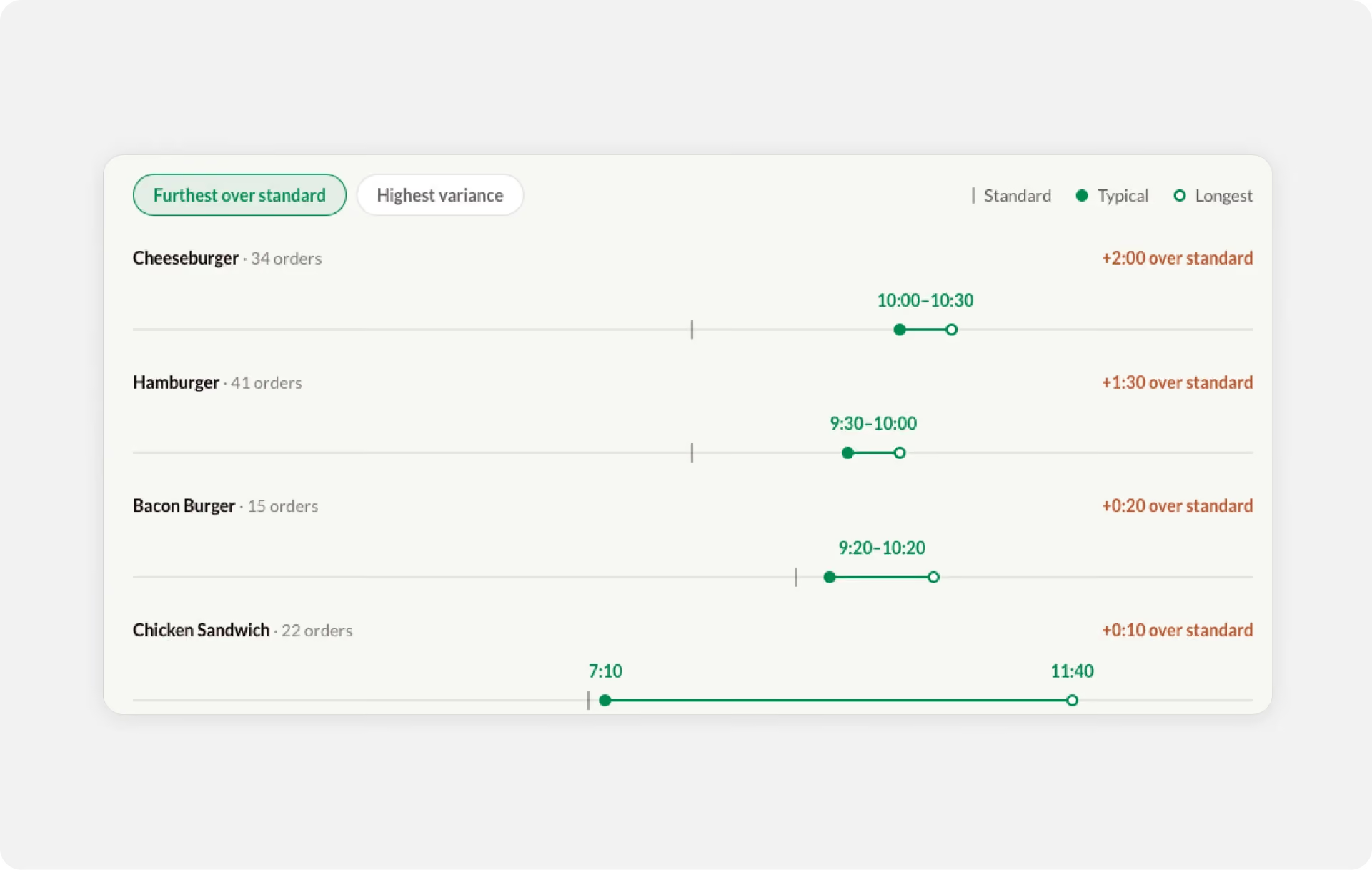
A low variance is the goal: it means the stations working that order finished in sync, and expo handed off a complete plate. A high variance is a signal to look closer, not a verdict on the whole kitchen. Drill down to the item level to see which item on that order finished out of step with the rest. Over time, a pattern at one item or one station is more useful than any single order's number.
What to do when variance runs high

Start with the item that's consistently the outlier. If it's finishing early, its entered cook time may be longer than what the station actually needs, and it's sitting done while other items catch up. If it's finishing late, the opposite is likely true, and the station needs a longer cook time or more attention during the rush. Either way, the fix is usually a cook-time adjustment or a look at station staffing during that window, not a bigger process overhaul.

The bigger picture

Speed of service was never only about going faster. It's about every item on the ticket landing together, on time, so the guest gets the order they were promised. But a metric only matters if it changes what happens at the pass, and quickly, but not faster. 

Item Completion Variance is designed to be read at a glance and acted on the same shift: a GM sees which item is out of step, makes a cook-time adjustment, and the next rush runs tighter. No dashboards to decode, no analyst in the loop. That's the point. The path to a better guest experience isn't more data. It's a number the line can act on immediately, at every location, without training. 

Item Completion Variance is one piece of a broader set of item-level metrics: Station Queue Delay, Item Prep Time, and Expo Dwell Time. Each one is aimed at a different point where service can quietly fall behind an average that still looks fine. On their own they're individual pieces; snapped together they reveal the whole picture the average never could. 

For decades, "speed of service" was one number on a report — a grade handed down after the fact that told you nothing about where the kitchen broke or how to fix it. That era is ending. Performance is moving to where the work actually happens — the item, the station, the moment — surfaced clearly enough to act on in real time, across every location at once. 

The average told you whether you hit the target. This tells you how to hit it, everywhere, every shift. That's not a better report. It's a new standard for what running a kitchen means.

July 22, 2026

Item Completion Variance, explained

An order can finish with a perfectly reasonable ticket time and still go out wrong. One item lands two minutes after the rest, sits under the heat lamp, and loses quality before the guest ever sees it. The average doesn't catch that. It just sees a completed order in an acceptable window.

Item Completion Variance is built to catch it.

What it measures

Item Completion Variance is the spread between when the first item on an order finishes and when the last one does, measured at the expo station where the full order comes together. If every item lands within a few seconds of the others, the variance is low and the order arrives as one complete, hot handoff. If one item finishes well before or after the rest, the variance is high, and that gap is exactly where quality gets lost.

The metric only applies to orders with more than one item, since a single-item order has nothing to compare against.

Why an order can look on time and still go wrong

Average ticket time answers one question: how long did the order take, start to finish? It doesn't answer whether every item on that ticket was ready at the same moment.

A kitchen can be hitting its ticket-time targets on average and still be sending out orders where the fries came up early and sat, or the entree came up late while everything else waited. Guests notice that gap even when the overall time looks fine on a report. Item Completion Variance is the number that surfaces it, order by order, instead of burying it in an average.

How to read it

A low variance is the goal: it means the stations working that order finished in sync, and expo handed off a complete plate. A high variance is a signal to look closer, not a verdict on the whole kitchen. Drill down to the item level to see which item on that order finished out of step with the rest. Over time, a pattern at one item or one station is more useful than any single order's number.

What to do when variance runs high

Start with the item that's consistently the outlier. If it's finishing early, its entered cook time may be longer than what the station actually needs, and it's sitting done while other items catch up. If it's finishing late, the opposite is likely true, and the station needs a longer cook time or more attention during the rush. Either way, the fix is usually a cook-time adjustment or a look at station staffing during that window, not a bigger process overhaul.

The bigger picture

Speed of service was never only about going faster. It's about every item on the ticket landing together, on time, so the guest gets the order they were promised. But a metric only matters if it changes what happens at the pass, and quickly, but not faster. 

Item Completion Variance is designed to be read at a glance and acted on the same shift: a GM sees which item is out of step, makes a cook-time adjustment, and the next rush runs tighter. No dashboards to decode, no analyst in the loop. That's the point. The path to a better guest experience isn't more data. It's a number the line can act on immediately, at every location, without training. 

Item Completion Variance is one piece of a broader set of item-level metrics: Station Queue Delay, Item Prep Time, and Expo Dwell Time. Each one is aimed at a different point where service can quietly fall behind an average that still looks fine. On their own they're individual pieces; snapped together they reveal the whole picture the average never could. 

For decades, "speed of service" was one number on a report — a grade handed down after the fact that told you nothing about where the kitchen broke or how to fix it. That era is ending. Performance is moving to where the work actually happens — the item, the station, the moment — surfaced clearly enough to act on in real time, across every location at once. 

The average told you whether you hit the target. This tells you how to hit it, everywhere, every shift. That's not a better report. It's a new standard for what running a kitchen means.

Switch to Fresh KDS with confidence

Follow this step-by-step guide for a quick and stress-free switch from Square KDS to Fresh KDS.

Why Speed of Service Matters

See why speed and consistency are key to restaurant success, improving guest satisfaction, revenue, and efficiency.

Get started for free.

Begin your Fresh KDS 7-day trial today by setting up your account. The process is completely free, and only takes a few minutes. No credit card is needed, and you can cancel anytime.

Get started - it's free
Boosting kitchen EFFICIENCY at